Founder’s perspective
– Conny Nilsson on building
the Swegon Air Academy
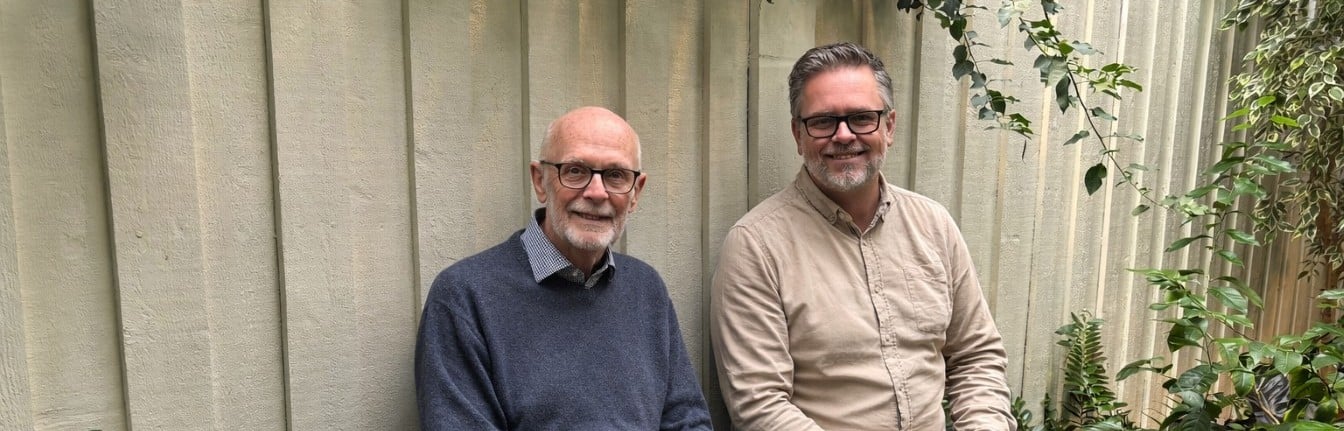
To mark 20 years of Swegon Air Academy, we are delighted to bring you the interview with the Air Academy's founder, Conny Nilsson. Mikael Börjesson, the current manager of Swegon Air Academy, met with Conny in December 2025, and their conversation looks back at the early days and the journey since then.
Mikael: Welcome, Conny. Great to see you, and to talk about Swegon Air Academy. As the founder of the Air Academy, tell me how it all started?
Conny: In 2004-2005, we wanted to focus on knowledge-sharing and raise the awareness of indoor climate issues. So, we asked ourselves: What to do? What is the scope? We thought about organising seminars for everyone interested. And so first we did check one country after the other. We were unique in our approach; there was nothing like it in the industry. The more we thought about it and the more we discussed with colleagues, the more we realised that an academy is perhaps a good idea.
And the Air Academy probably helped us attract so many prominent speakers to our seminars, but we also realised that we had to be smooth if we wanted the best speakers. And it worked, it really worked. And the knowledge-sharing came with positive respect beyond our expectations.
One of the very first topics for our Swegon Air Academy seminars was EPBD, which was relatively new at the time. Only one day before this interview, Air Academy held yet another seminar, in a form of a webinar, on the EPBD recast. Full circle.
Mikael: So, you decided on an academy, was there a vision for brand positioning?
Conny: Yes, to we were to put Swegon on the map. In the first year, we started off slowly. We hosted four or five seminars, and then it grew from there. At our peak, we held 22-25 seminars a year!
Brian Edwards, Professor Emeritus and also the co-author of our books, was one of our first experts. Enno Abel and Arne Elmroth, who knew each other very well through their academic work at Chalmers University and technical high schools in Sweden, were also prominent professionals. Their colleagues, Lars Ekberg and Per Erick Nilsson, both known for their expertise, remain close with Swegon Air Academy.
Small note: Lars Ekberg is still very much part of the Swegon Air Academy, as one of the experts on the Think Tank – gathering leading researchers and other experts who meet regularly to discuss trends, insights, research, and the different aspects of indoor environments and how they influence buildings and people.
Mikael: When was the comprehensive book ’AIR’ born and what was the reasoning behind such an immense project?
Conny: The reason for the book was that continuous complaints from people regarding the indoor climate. Although, the project grew bigger than we expected. We decided, however, to go for it. It was shocking to see the book complete in 2008, it was so big.
The challenge was that needed to think everything through carefully. Lars Ekberg was our technical editor, and I think the reason for why ’AIR’ was well-received, was that all writers and authors were well-known in their areas of expertise.
Mikael: And also so many seminars, were there so many experts?
Conny: Oh, yes. Olli Seppänen from Finland, Francis Allard at La Rochelle University in France, David P. Wyon as the international expert on indoor climate research. Martin Borgström on fire protection in Sweden, Jarek Kurnitski as REHVA expert from Estonia and Maia Virta from Finland. Mario Bodem on passive houses in Europe, Max Tillberg from Sweden, Olaf Harms from Germany and Pawel Wargocki from the Technical University of Denmark. Peter Holzer from Austria, Severine Kirchner and Susanne Deoux, two experts from France, and Vince Ugarow from the UK focusing on high-rise buildings. Peter Simmonds brought an expert voice from the US on technical installations, and there were many more.
Mikael: What were the reactions from Swegon and customers? Or, in fact the target market also included consultants, building owners and contractors, what did they think?
Conny: I think most of my colleagues from Swegon were positive, but perhaps a bit hesitant at first. After a while, they realised that the Air Academy was not focusing on products but on other things that complemented and enriched their own knowledge.
Mikael: 20 years ago, we offered indoor climate knowledge, and that is still highly valued expertise.
Conny: Yes. In the very beginning, we discussed why so many were unhappy with the indoor climate, while still telling our children to go outside for fresh air. Then we questioned, what happens with the air coming from the outside and let into the building?
That question started the contemplation about ventilation, air handling etc. and we described it all. It basically went from there. The importance of taking outside air in, how, where, air filters, heaters and coolers, there was no stop. Our main focus was on describing how the air went through the air handling unit.
Mikael: Did things change over the years, the ambition level or the vision?
Conny: I don't think so, there was so much to tell. We took one country at a time, and once we had an engaged speaker, we could do multiple seminars. We rather extended the geographic range than changing the purpose. The philosophy was pretty much the same.
And the philosophy is still highly relevant, air from the outside to the inside is still our focus. What has changed, is the way we spread the word, we have gone from seminars to webinars.
Mikael: I guess that today’s webinars are more cost-effective, but also that the result differs compared to a physical seminar. What do you think?
Conny: In our peak years we were conducting 25 seminars per year, always at different locations, and each seminar hosted two to three experts. It was costly at the time, but it was appreciated, we had a great audience and people spent time on us. Today, people seem to struggle with time.
One challenge was that every country was so different, they shaped each seminar. In France, for instance, we would be at small chateaus in beautiful locations. In Sweden, it would be a bit different, and I remember Italy with a very young audience.
I remember St. Petersburg, Russia, we used welcome close to 200 people!
Mikael: That's amazing. But then you left, after more than 6 years, the last two with John Woollett. How come?
Conny: To be honest. I really liked my job, it was fantastic. It was the best years of my professional career, always very interesting and I learned a lot. I went to work with joy every day. However, retirement was on the agenda and I couldn’t find someone to run the Air Academy, until John Woollett came along. He was, and still is, an outgoing Englishman, and we worked closely together for a couple of years.
And in 2011, Petra Vladykova was invited for an interview. John had met her at a conference where she presented her PhD from the Technical University of Denmark. Petra and John ran the Air Academy until 2015 when John left for new challenges. This was when Mikael Börjesson joined.
Mikael: If you were to start Swegon Air Academy today. Would it be the same?
Conny: To be honest, I am not sure. Parts of it, perhaps, the technology and online way of working is obviously new and a good way of working.
Mikael: Yes, online webinars differ from physical seminars. Although both allow us to share our knowledge and discuss important issues, I think that the interest in personal meetings is growing again.
Mikael: Funny thing though, from my perspective, so little has happened – we are still fighting the same fight.
Conny: Yeah, it is still the same fight. But keep up the fight – it is a good one.
It is still the same fight
To sum up, at Swegon Air Academy we are fighting the same fight. It has been 20 years, and importance of sharing the knowledge about indoor climate is the same, as everyone needs a good indoor environment. Knowledge-sharing is essential, and our experts at Swegon Air Academy are key to spread what is there to know about the indoor climate.
Learn more about us
About Air Academy - what we do, how we reflect and who we are as Swegon Air Academy.